Lewis and Clark

lewisclark

Originally posted eight years ago, I have updated the links in this post.

Monday, July 24, 2006:

A great article in the Billings Gazette: Retracing Clark’s Journey to Pompeys . Two hundred years ago, July 24, 1806 the Corps of Discovery was on the Yellowstone River. If not for the Louisiana Purchase in 1803, which President Thomas Jefferson thought Unconstitutional but made anyway, and the Corps of Discovery; the United States would not be the size it is today. The Louisiana Purchase was the first step in westward expansion that led to Manifest Destiny, the Mexican War; the Treaty of Guadalupe Hidalgo; February 2, 1848 , giving the United States California and in turn the Gadsden Purchase in 1853 . It is debatable whether the Mexican War was a good thing. There is no such thing as a good war. There is nothing good in war except its ending.

The fact is the United States came out of that war with California and Texas. California, in 1848—49, was a place that people wanted to go. Land was cheap, abundant, and the weather was fair. This desire of people to get to California for its land and raw materials led to the construction of the Transcontinental Rail Road. The Road was called for by Congress in 1862 with the Pacific Rail Road Bill. The building of the Transcontinental Rail Road was the greatest industrial-economic feat in American History, and it was made possible in part by the exploration of Lewis and Clark.

You Can't Park There…

One of the things I don’t like about the summertime is people park their bikes in my way. I have Cerebral Palsy, and use a wheelchair. More often than not, in the summertime, I’m faced with the problem in the image below.

20140708-131609-47769664
This is the handicap ramp to my favorite restaurant. I cannot get in because it is blocked by bikes. I have enough trouble getting by the bench.

20140708-132031-48031827
Now, I know that restaurant is not responsible for it, but it is extremely annoying. So in the future if you ride your bike to this or any other restaurant, please keep in mind that you should not park in front of the wheelchair ramp.

06 The Problem with Intelligent Design

I  have written a lot, far more than I expected to, on the topic of Intelligent Design. The central question at issue: Is ID science? Some believe it is, some believe it isn’t, and some believe its debatable. I have come to the conclusion it is not science. The above episode and the links below explain why I have come to that conclusion.

Links

New Platform New Blog Format

I have lost count of how many attempts I have made at maintaining a blog for my site. On the one hand, I’m not even sure blog is necessary. On the other hand, there should be a place for smaller bits of content, pictures and travel journal entries. I have tried other hosting platforms, and I have found them lacking in one form or another. So, I have decided to maintain this blog on my site. Please comment, like, and share.

The Constitution, Intelligent Design/Creationism, and social Darwinism

Salvador Monteagudo in his February 23, 2011 blog post “Creation and Evolution: What is the debate about?” at Goodnewseverybody.com (which I highly recommend) linked to one of my posts on Intelligent Design: “More on Ben Stein and Expelled”, so I read his post. I was intrigued and posted the following comment.

“Ben was just focusing on how the education system in America is just one-sided (e.g. not open to Creation) ….”

Intelligent Design/Creationism is inherently religious in the Judeo-Christian sense; therefore, it cannot be put on equal footing with evolution in the science classroom. To do so would violate the Establishment Clause of the First Amendment, and thus the Separation of Church and State. Because the public school is an agent of the state, if the school taught Intelligent Design/Creationism in the science classroom it would be promoting a specific religion. That is what a Federal Court found in Kitzmiller, et al. v. Dover Area School District, et al 2005.

Intelligent Design/Creationism is not science. The main postulate of Intelligent Design is a preexisting intelligence, which cannot be proved, nor disproved by observation or experiment. As such, any preexisting intelligence would be outside the hot big model of the universe, and any actions taken by such a preexisting intelligence would have been before the beginning of time. Therefore, according to the law of economy, a preexisting intelligence should be cut out of any model of the universe, for any actions taken by it cannot be observed. Intelligent Design/Creationism is a political issue; therefore, the proper place for it to be discussed in the social studies classroom. Religion in general plays an important role in American society. How religion affects society by shaping political issues should be and is examined in the social studies classroom from the Early Colonial Period of American history, to Civil War, and from there to twenty first century current events. Intelligent Design/Creationism is just another issue in the course of that examination.

“I feel this Evolution theory of `survival of the fittest’ bring on prejudice, like racism-see personal story, classism, etc.…”

There is a different between scientific theory of evolution and social Darwinism. The scientific theory of evolution tells us that the process of natural selection “creates” a group of animals that is best able to survive in a given area. To be sure, this is very simplistic definition. Natural selection embodies an extremely complex set of natural processes which have created the ecosystems we observe around the world. Social Darwinism and concept of survival of the fittest are dependent upon the postulate that humans are animals or machines bound by natural laws, which goes back to Thomas Hobbes in the Leviathan, 1651. In it he gave a materialistic view of mankind. Hobbes stated:

Life without a government—the state of nature is war… every man against every man… and the life of man is solitary, poor, nasty, brutish, and short.

Government is instituted to deliver man out of the state of nature, Hobbes, Locke, and Rousseau would agree. Rousseau differs in his definition of the state of nature. Social Darwinism, then, is a nineteenth century political theory, which draws on Hobbes’ definition of the state of nature. However, social Darwinism postulates that eternal conflict is necessary for social and political progress. This view was expressed by Hegel and then Hitler which is where racism comes into play. Any state that is dependent upon conflict for social progress is also dependent upon perpetual prejudice and racism. To legitimize those concepts, dictatorships and totalitarian governments have distorted the scientific theory of evolution.

Supporters of Intelligent Design/Creationism often distort the scientific theory of evolution. They maintain that science is atheistic, and evolution is an example of that atheism. Evolution is not atheistic; neither is science. Evolution does not say there is no God; nor does it say if one accepts evolution one must be an atheist. Intelligent Design is used to promote Christian convictions, and bad science. In and of themselves, Christian convictions are not bad, nor is Intelligent Design. But, it must be said that some people who support Intelligent Design as science want nothing less than a Christians only America because they know what is best for all.


Links

More on Ben Stein and Expelled

Ben is quoted in the Expelled Leader’s Guide stating the following “In today’s world, at least in America, an Einstein, or a Newton, or a Galileo would probably not be allowed to receive grants to study or to publish his research” (2). The assertion that the work of these scientists would be suppressed in today’s world, for Europe has not embraced Intelligent Design either, takes their achievements out of context and distorts their scientific significance. Someone as intelligent as Albert Einstein could probably publish at least three scientific papers while holding down a job, which is what Einstein did in 1905. According to Stephen Hawking in his book, The Universe in a Nutshell, Einstein held a minor position at the Swiss patent office and during that time “he wrote three papers that both established him as one of the world’s leading scientists and started two conceptual revolutions, revolutions that changed our understanding of time, space, and reality itself.” That suggests that Einstein demonstrated the kind of independence and initiative that American society rewards. However, Hawking makes clear that by 1921 the Theory of Relativity was considered too controversial and was not completely accepted by the scientific community, and now it is completely accepted by the scientific community. Additionally, the predictions of the Theory of Relativity “have been verified in countless applications.” Alas, the same cannot be said for Intelligent Design, but then, it is not a scientific theory.

As for anyone achieving anything comparable to what Isaac Newton achieved, the first physicist that comes to mind is Stephen Hawking. He, like Newton, is Lucasian Professor of Mathematics at Cambridge University. Newton was elected to the position in 1669 and his Principia Mathematica was published in 1687. Thus, he continued to publish scientific work while he held that position. The Principia Mathematica is probably the single most important work ever in the physical sciences. As Newton said, “Gravity explains the motions of the planets, but it cannot explain who set the planets in motion. God governs all things and knows all that is or can be.” That statement does not support irreducible complexity; it merely draws a distinction between scientific physics and metaphysics, which is in line with the principle of economy. An intelligent designer is not part of the Theory of Gravity, for his actions cannot be observed. Therefore, they should not be part of any scientific theory of the universe. Similarly, in A Brief History of Time, Hawking also adhered to the principle of economy, for he argued that any actions taken by God before the big bang (the beginning of the universe) would have no observable consequences, thus they should not be part of any model of the universe.

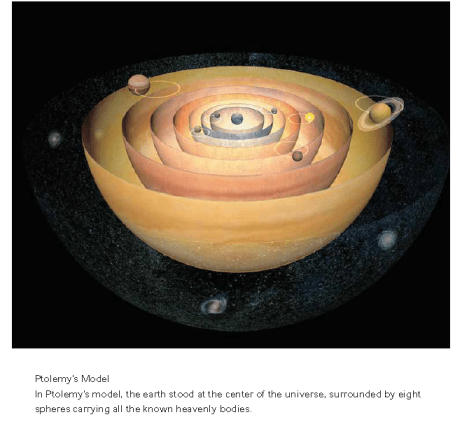
Galileo was only arrested after the Catholic Church bent over backwards not to. According to James Burke in his series The Day the Universe Changed in the program “Infinitely Reasonable,” the view of the universe was based on Aristotle’s 2000 year-old observations which placed the earth at the center of the universe, and the Moon, the sun, the planets, and the stars in orbit around the earth. It was a kind of straightforward as he saw it view. Later, Claudius Ptolemy constructed a complete cosmological model about 1210.

052508-1811-moreonbenst11

The above model was predominant for well over 400 years then in the 1500s, to correct problems with the calendar; a Polish priest Nicholas Copernicus examined the heavens at the request of the Catholic Church. Copernicus discovered that a sun centered system agreed with his observations. Thus, the earth became a moving planet rather than the stationary center of the universe. Copernicus’s manuscript was not published until 1543 after his death. His Heliocentric Theory could have upset the prevailing Aristotelian view of the universe had it been taken seriously. However from the Church’s point of view, the Copernican Theory was a brilliantly convenient mathematical fiction, for everyone knew that the heavens really did behave the way Aristotle and the Bible had predicted.

Nearly a century passed before the theory was taken seriously. Then two astronomers Kepler and Galileo publicly supported the theory. Kepler proved the accuracy of the Copernican Theory. Additionally, Kepler found the planets were not moving in circular, but in elliptical orbits around the sun. Galileo’s observations provided further proof that the planets did move away the Copernican Theory predicted. Moreover, Galileo observed that Jupiter had moons in orbit around it, our moon had mountains like the Earth, and the Sun had spots. In 1632, Galileo published A Dialogue Concerning the Two Chief World Systems. In it, he defended the Copernican Theory, and argued for the separation of science from the Church. He was arrested and the Copernican Theory was band, but only after Galileo refused to compromise.

Set in the proper context the significance of their work is clear, and so is the importance of publication of findings to the process of discovery. From Ptolemy to Einstein and Einstein to Hawking, each has verified, modified, or disproved the work of his predecessors that is the process of the scientific method. The problem with Intelligent Design is that it makes no verifiable predictions that can be tested by experiment. To claim that the work of the supporters of Intelligent Design is being suppressed like the work of Galileo misrepresents Galileo’s work. The fundamental difference between the work of Galileo and the claims of the supporters of Intelligent Design is that Galileo had evidence that verified the Copernican Theory and disproved the Ptolemaic Theory.

The supporters of Intelligent Design have found no evidence that disproves the Theory of Evolution. Expelled Exposed answers the film’s claims of suppression almost point for point, the fact is that Intelligent Design as produced no research to suppress, and the claim that researchers are being dismissed from their positions because of their support for Intelligent Design is also refuted. In fact, Expelled Exposed presents a compelling argument that each situation was distorted to fit the story line of the film. Additionally, supporters like the Discovery Institute produced a list of scientists that claim to have doubts about Evolutionary Theory. However, as the video below demonstrates the claim is dubious.

The Discovery Institute boasts that over 700 scientists “are skeptical of claims for the ability of random mutation and natural selection to account for the complexity of life.” Like Einstein’s reply to a book titled 100 Authors against Einstein, written after the Nazis took power in Germany, “Why 100? If I were wrong, one would have been enough.” I ask why 700 scientists? If Evolutionary Theory were wrong one would be enough.


Links

Ben Stein’s: Expelled the anti-science, anti-evolution “documentary;” bad science, bad reviews

One of the few drawbacks of being a full-time master’s degree student in history is that I do not have the time to keep track of the latest news on my favorite topics such as Intelligent Design. The movie Expelled: No Intelligence Allowed released on Friday, April 18, 2008, hit theaters near the end of the spring semester. A time when I was in the middle of writing my last five page book review, two ten to twelve page papers, and preparing for a final exam, thus I must have missed the television trailers promoting the film. I was not aware that a movie promoting Intelligent Design was due for release until today. I began my day with the intention of updating my Intelligent Design links page, and found that nearly two a half years after the Dover Pennsylvania decision that held Intelligent Design was not science and was Creationism; therefore, it violated the Establishment Clause of the First Amendment, Intelligent Design was still seriously being advocated as a scientific alternative to evolution.

As I have stated, Intelligent Design is a social theory. It is not science. However, according to reviews, for I have not seen the movie, Expelled’s main theme is that “big science” is suppressing evidence that supports Intelligent Design, which is not true for Intelligent Design is not a scientific theory. No scientific evidence is offered in the movie to support Intelligent Design, according to reviews it is simply an attack on evolution. Ken Miller, biology professor at Brown University, argued:

“Expelled” is a shoddy piece of propaganda that props up the failures of Intelligent Design by playing the victim card. It deceives its audiences, slanders the scientific community, and contributes mightily to a climate of hostility to science itself. Stein is doing nothing less than helping turn a generation of American youth away from science. If we actually come to believe that science leads to murder, then we deserve to lose world leadership in science. In that sense, the word “expelled” may have a different and more tragic connotation for our country than Stein intended. Boston Globe, May 8, 2008.

Furthermore, Miller expressed concern that popular culture is increasingly turning against science and movies like Expelled are hastening the process.

John Rennie, the editor in chief of Scientific American, would agree with Miller. Rennie asserted that Expelled is “a shameful antievolution film [that] tries to blame Darwin for the Holocaust” (Ben Stein’s Expelled: No Integrity Displayed, April 9, 2008). Scientific American also did a podcast review of the movie as well as a discussion with the editor of the movie, Mark Mathis (part one, part two) in addition to other articles. Again, Intelligent Design is not science; therefore, mainstream science is not suppressing evidence that supports design theory because there is no evidence that supports Intelligent Design as a scientific theory. However Expelled maintains that Intelligent Design is cutting-edge science that the establishment is trying to suppress. In contrast, after evaluating the reviews and the evidence provided in the Dover decision and other sources it is clear that Intelligent Design is Creationism. It is unfortunate that in this movie Ben Stein appears to be a rebel without a clue. Hopefully, the public will choose to spend its money elsewhere.


Links

The Separation of Church and State

12/23/18: Links to sources in this post have been updated where necessary.


Introduction

Tuesday, December 20, 2005 in the United States District Court for the Middle District of Pennsylvania Judge John E Jones III handed down the Court’s ruling in the case Kitzmiller, et al. v. Dover Area School District, et al.1 The decision was a stunning defeat for Intelligent Design in the science classroom. The Court found that the Board’s Intelligent Design policy violated the Establishment Clause of the First Amendment. William Buckingham former Dover Area School Board member and one of two who spearheaded the Intelligent Design policy was asked for his thoughts on the ruling. Buckingham said, “I’m still waiting for a judge or anyone to show me anywhere in the Constitution where there’s a separation of church and state…. We didn’t lose; we were robbed.”2

The Separation of Church and State

In my seven years as a teacher, I have never seen such a fundamental misunderstanding of a concept as I have with the separation of church and state. Therefore, I take up Mr. Buckingham’s challenge, and attempt to explain the concept. The phrase is not found in the Constitution, but the concept is. The Establishment Clause of the First Amendment states, “Congress shall make no law respecting an establishment of religion, or prohibiting the free exercise thereof….“ 3 The Bill of Rights applies to the states through the Fourteenth Amendment. Thus, the state shall make no law respecting an establishment of religion, or prohibiting the free exercise thereof…. Basic to this concept is tolerance, as John Locke argued in his Essay on Toleration 1689, “all religions are worthy of respect, none priority”4 The United States was founded upon morality that is not exclusive of or to any religion; therefore, to protect the free exercise of religion no public agency funded by tax money can or should endorse any religion. The minute the state or any agency of it adopts one religion it prohibits the free exercise of all others, thus making any citizen who does not practice the state religion an outsider in their own community, and not entitled to its basic rights because they are different. The Founding Fathers called that Tyranny of the Majority.

Pluralism

Some would say the United States is not a pluralistic nation, but a Christian nation. If that is the case, there would be no need for the following clause in Article Six of the Constitution which states: “…no religious test shall ever be required as a qualification to any office or public trust under the United States.”5 This would seem to support the Establishment Clause of the First Amendment. But, some still would say that the United States is a Christian nation. If that is true, who then can become a citizen of this Christian nation? Only Christians is the answer. Where do the great numbers of non-Christians go in that case? The fact is the United States is a pluralistic nation. Congress has upheld this in the Immigration and Nationality Act that in general states:

  1. a period of continuous residence and physical presence in the United States;
  2. residence in a particular USCIS District prior to filing;
  3. an ability to read, write, and speak English;
  4. a knowledge and understanding of U.S. history and government;
  5. good moral character;
  6. attachment to the principles of the U.S. Constitution; and,
  7. favorable disposition toward the United States.6

There is no religious test for citizenship; the most important of the requirements is an attachment to the principles of the Constitution. That is a political requirement. Who can become a citizen? Any person who has a commitment to the political principles on which this nation is based; none more basic than the separation of church and state. The requirement of good moral character speaks to good citizenship. Thus, the United States is a pluralistic nation. One that shows respect of all religions, and not one that shows the intolerance of Mr. Buckingham’s statement, “This country wasn’t founded on Muslim beliefs or evolution. This country was founded on Christianity and our students should be taught as such.”7

The Supreme Court in many cases: Lemon v. Kurtzman 1971, Edwards v. Aguillard 1987, and County of Allegheny v. ACLU 1989; to name three, has upheld the concept of separation of church and state. In Lemon, the Court set a three pronged test to determine if the government’s action is repugnant to the Establishment Clause of the First Amendment. It is the purpose of the Supreme Court to state what the law is. The concept of the separation of church and state started with John Locke. Then, it was expressed in Article Six of the Constitution, and The Bill of Rights. One need not be Christian to become a citizen, and one can be of any religion and become a citizen.

Conclusion

Some Christians do not like the idea of pluralism; they do not see pluralism as a national strength, but a national weakness. These Christians see a commitment to biblical truths as necessary for the nation. In that case, pluralism is repugnant to the Bible as they read it. Pluralism has led, in their view, to moral relativism, and an amoral society. They have the right to hold that view because of the First Amendment. By denying the separation of church and state, they hope to give Christianity priority over other religions and points of view, thus denying those citizens who do not believe as they do the right to be different. Justice Robert Jackson, in 1943, stated “The test of [freedom’s] substance is the right to differ as to things that touch at the heart of the existing order.”8 That would seem to make freedom of thought as much of a right as freedom of religion. The small number of Christians who do not like the idea of pluralism; either do not understand or do not respect the fact that this nation is made stronger by the separation of church and state, and the pluralistic nature of the First Amendment.

Notes

1 Kitzmiller, et al. v. Dover Area School District, et al, (2005), 1-2, https://jgkeegan.com/id/kitzmiller.pdf, (Hereinafter Kitzmiller).

2 Judge rules against ‘intelligent design’ ‘Religious alternative’ to evolution barred from public-school science classes’ accessed December 16 2018, http://www.nbcnews.com/id/10545387/ns/technology_and_science-science/t/judge-rules-against-intelligent-design/#.XBZUUOJOk2w.

3 Constitution of the United States Amendment One, https://www.archives.gov/founding-docs/bill-of-rights-transcript#toc-amendment-i.

4 Quoted in Richard L. Greaves, Robert Zaller, and Jennifer Tolbert Roberts, Civilizations of the West The Human Adventure: Volume B The Renaissance to 1815, (New York: Harper Collins, 1992), 566; John Locke, “A Letter Concerning Toleration,” The Federalist Papers Project, accessed December 16, 2018, http://www.thefederalistpapers.org/wp-content/uploads/2012/12/John-Locke-A-Letter-Concerning-Toleration.pdf.

5 Constitution of the United States Article Six, https://www.archives.gov/founding-docs/constitution-transcript#toc-article-vi-.

6 Naturalization, accessed January 11, 2006 http://uscis.gov/graphics/services/natz/. The page is no longer available and is not indexed at Archive.org.

7 Kitzmiller p 103.

8 Quoted in Paul E. Johnson, Gary J. Miller, John H. Aldrich, David W. Rohde, and Charles W. Ostrom, Jr, American Government: People, Institutions and Policies, 3rd ed. (Boston: Houghton Mifflin, 1994), 103.


Links