

via Instagram http://ift.tt/1GMSqfa

Originally posted in October 2009, this post is about writing.

Does the writing process end? Is an author ever really satisfied with the end product of all his labor, or is that product just what could be produced in the time available? I started researching my masters thesis on the aftermath of Pearl Harbor in May 2008. I thought it would take no more than six months to research and write, but I just submitted my Committee draft eight days ago. So much for researching and writing in six months, and my thesis committee, which consists of three history professors from Millersville University, will most likely require that more editing be done before the final draft will be accepted by the University. When will it end?
I was told some time ago by one of my professors that the entire process would take a year or more. She was right, but I did not believe her. The research and initial writing took a total of about nine months on and off. At the end of August 2008, I had written a preliminary prospectus and put research aside to concentrate on classwork. By January 2009, I was eager to continue research, and in March, I was prepared to investigate primary sources available at the National Archives in Washington, DC. The trip to the National Archives was an exciting and unique experience, which has been one of the highlights of my research. I reluctantly submitted a short paper to the Phi Alpha Theta Conference in April. I was not happy with the paper or my presentation to the conference, but the paper did have some positive aspects, which formed the spine of my thesis.

My presentation was lackluster at best, so I did not receive the feedback I had hoped. However, I sent the paper to three of my friends and their constructive criticism was extremely helpful. By mid-July, I completed the first half of the rough draft of my thesis, and submitted a completed draft to my thesis advisor by mid-September. After incorporating his suggestions and some other editing, a draft was submitted to my thesis committee on October 1, 2009. The process sounds simple now, but each stage had its own unique difficulties.
The overarching difficulty was and is novelty; I have never attempted a project on such a scale before. Although I have written a previous article “United States, Japan, and Pearl Harbor”it did not undergo the level of editing and rewriting that my thesis has and will continue to undergo before I complete it. The constructive criticism I have received has improved the work, and I am indebted to my friends and my thesis advisor for their assistance. In addition to novelty, starting was also difficult. Not in the sense that I did not know where and how to begin, or I did not have a general direction, but I lacked a clear and interesting path connecting the topics I wanted to discuss. Hopefully, the Committee draft has solved that problem. I will know by next Friday night. I knew what I wanted to discussing in my thesis by the time I completed the conference paper, which was probably one of the reasons my thesis advisor suggested I participate in the conference.
The next difficulty was constructing an argument. Fortunately, the aftermath of Pearl Harbor provided ample historiography to analyze. At the center of the historiographical debate was whether the Navy and the United States government treated, the officer in command of the Pacific Fleet on December 7, 1941, Admiral Husband E. Kimmel, unjustly. Seeking an answer to whether Kimmel was unjustly treated, historians have mined the testimony, exhibits, and conclusions of the nine official investigations into the attack, as well as other sources. Based on that analysis, there are those who assert that Kimmel as Commander-in-Chief Pacific Fleet could have done more with the resources available to him. Therefore, relief and retirement at the rank of Rear Admiral was fair. Furthermore, posthumous advancement on the retirement list is unwarranted. Conversely, there are others who maintain that Kimmel was made a scapegoat and unjustly punished. Therefore, to correct the injustice of the Roberts Commission charge of dereliction of duty; they argue that Kimmel should be advanced on the retirement list to the rank of Admiral under the Officer Personnel Act of 1947.
It seemed simple enough; all I had to do was determine what aspects of each argument failed to explain what happened in the in the aftermath of the attack and then offer an argument that was in between the two extremes. So, borrowing the main concept of Richard Godbeer’s Sexual Revolution in Early America that contemporary knowledge and belief must be set aside in order to understand historical events in their proper context, I found that the argument that Kimmel could have done more with the resources available to him relied on such contemporary knowledge. However, explaining that failing was extremely difficult and led to the construction of the most difficult paragraph to write. I hope the paragraph clearly explains the concept.
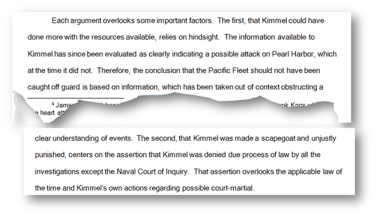
I am nearing the end of the process and the well is running dry. I do not know how much more rewriting I can do. I will find out how much rewriting I will have to do next Friday afternoon. My thesis is at the point where there is not much more I can do with it. I am certain it can be improved, but I am not sure how. Now every time I reread a paragraph or a section with the idea of making some changes, I leave it alone. Is it because once on the page is good, or am I just tired and running out of ideas? I do not know which is probably why there it is a thesis committee in the first place. Two sets of fresh eyes and one set that is familiar with the work (my thesis advisor) will help in its improvement.
I chose to write a thesis as part of my master’s degree program because I wanted to learn more about the process of writing history. It has taught me that there is a time in every writing project when the author simply runs of steam and that is when the writing process truly ends.

Recently, I purchased a new laptop. I haven’t had a chance to install Acrobat reader. However, Windows 8.1 has Microsoft PDF reader. This morning I came across a PDF that I wanted to add to one of my notebooks, so I attempted to insert it as a print out. OneNote 2013 could not recognize it. I downloaded and installed Adobe acrobat reader, and tried again. It worked. Microsoft PDF reader does not work with OneNote 2013. I don’t understand.
In earlier post I explained the reasoning behind the Document Archive not having a traditional HTML navigational structure. The purpose is to provide students and teachers a distraction free experience, so students can focus on the assignment they have been given. Nevertheless, teachers need a complete list of resources that are available at keegan.wiki | Document Archive . Below is a Word Document containing a complete list of links to instructional materials available at the archive. I hope teachers will find it useful.
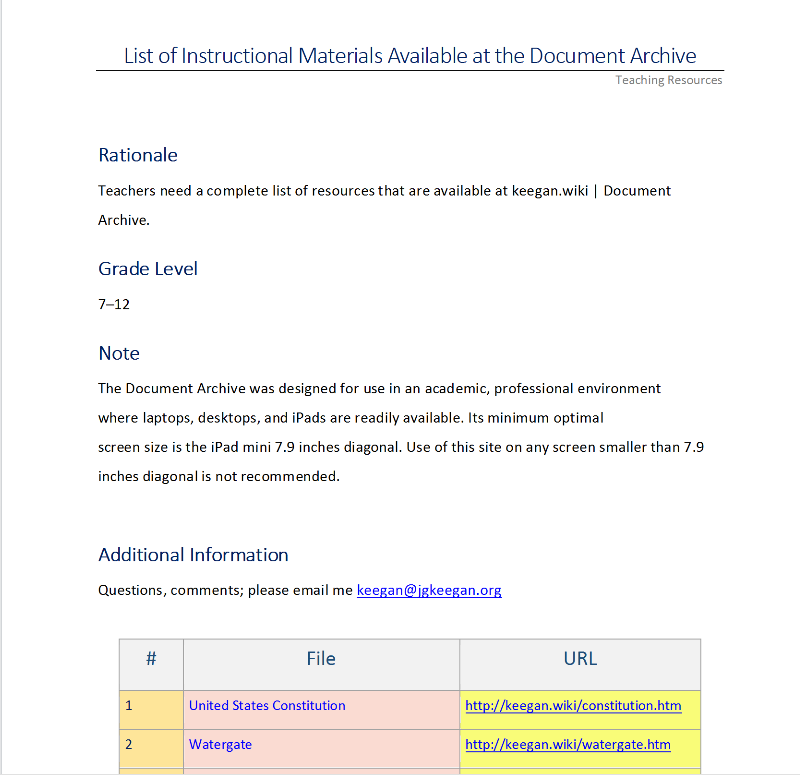
Since Microsoft Office365 announced that it will discontinue the public facing website feature, I have been working on an alternative. I described the first part of that alternative in an earlier post. Once I moved all my Word Documents, and PowerPoint presentations to OneDrive for Business, I had to find a place to put the webpages. Until recently, I used jgkeegan.org, which pointed to the public facing website, as my Document Archive. That is to say I put any webpages there I want to share publicly, but I do not feel belong on my personal website jgkeegan.com. In the main, the pages stored there were for the presentation of teaching resources on a variety of history/social studies topics.

I could not move the domain that pointed to the public facing website because I use that for email. So I registered another domain keegan.wiki. I have just completed creating public links for all my documents in OneDrive for Business and rewriting all the webpages in HTML5 for the new domain. The Document Archive is live. I should note the archive does not have a traditional HTML navigation structure, while the site has an index page it does not link to any other page apart from the copyright statement. Each page stands on its own and is linked to from my Teaching Resources page, the Topics page, or from a page about a specific topic. Additionally, each page is designed for use in an academic, professional environment where laptops, desktops, and iPads are readily available. Its minimum optimal screen size is the iPad mini 7.9 inches diagonal. Use of this site on any screen smaller than 7.9 inches diagonal is not recommended. This allows teachers, the target audience, to use a specific resource page without any distractions such as links to other pages within or outside the site. Except for a link to the copyright statement in the footer, students are presented with a webpage that has a finite set of links related to a specific assignment.
My hope is that teachers across the United States will find the resources in this document archive useful.
I learned last week that the Office365 public website feature is being discontinued. Microsoft is no longer offering the feature to new Office365 customers, and existing customers have two years that is until March 2017 to find a new hosting platform and move their data. The loss of the public website did not concern me as much as the loss of the ability of users of my website to view Word documents and PowerPoint presentations in Office Online (Office Web Apps). As I explained to the Sharepoint Online support team at Office365:
One of the key features of the public facing website is the ability for my users to view documents in office Web apps. Microsoft lists a number of third-party solutions none of them have the ability to view documents in the office Web apps (See jgkeegan.com/plans/home.htm). One of the reasons I activated the public facing website feature is the fact Office Web Apps provide somewhat more security from copyright infringement than does the standard PDF file. I have tried to share with (everyone) documents with my one drive for business and my team site, but that has never worked. I require a solution that allows users to be able to view documents in Office Web Apps. None of the third-party solutions listed in the knowledgebase article provide that functionality.
It took two service requests, but they were able to show me a solution. One that, apparently, has been available all along. One drive for business has the capability to share documents and presentations publicly. And one of the members of the support team was kind enough to walk me through the process.
The following video demonstrates how to share an Excel document stored on OneDrive for Business from within the client. The process is the same with Word documents and PowerPoint presentations.

Next click the three dots.Then, click share.

Then, Click Get a link.

After that choose between allowing the public to only view the document or give everyone in the world the ability to edit it. Most, if not all, of the time choose view only.

After clicking create link A public link is generated that can be placed on any webpage or emailed to anyone. Note also the ability to stop sharing any document by clicking disable.

The only drawback, and this is true of the public website if it does not have a vanity domain, is that anyone can print or embed my content on their website without asking permission. I am not happy about that. So, over the next two years I will be moving all my content from the public facing website to OneDrive for business.

I have just completed a new resources page for the United States Constitution. I have taken all the resources from the unit the Launching of a New Constitution, and simply listed them without the lesson plans or reference to them. Additionally, I have embedded appropriate Schoolhouse Rock videos on the page. Many users have asked for the resources to be presented in this format.
 The Keegan Blog